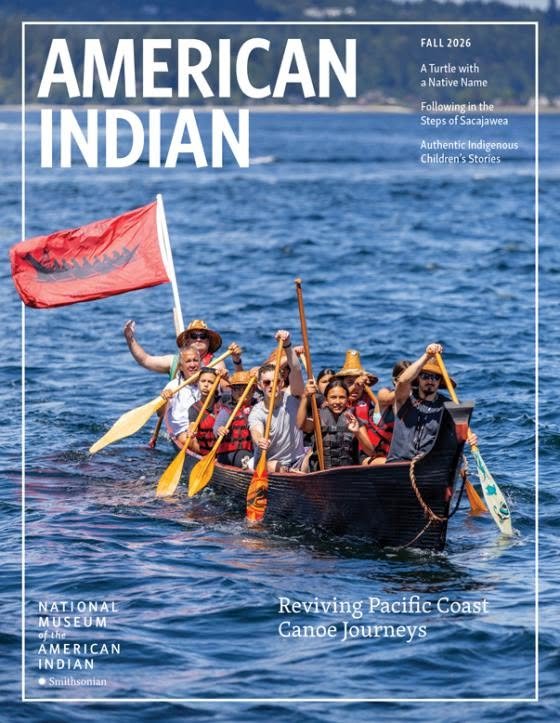
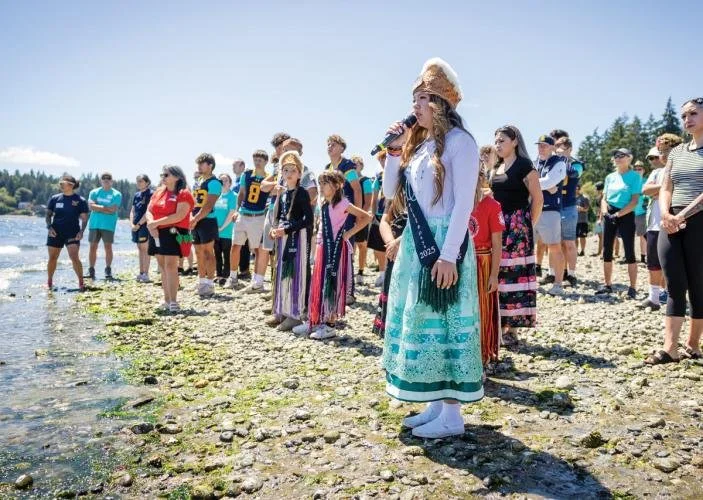
This past July at a rocky beach on Suquamish tribal lands about 18 miles northwest of Seattle, canoes from Indigenous communities along the North Pacific Coast of Canada and the United States began arriving in the early afternoon. At first, they came one or two at a time, but soon more than 70 had arrived, ranging from traditional cedar wood dugout canoes to lighter fiberglass ones—many carrying flags and painted with symbols and names reflecting their Indigenous cultures.
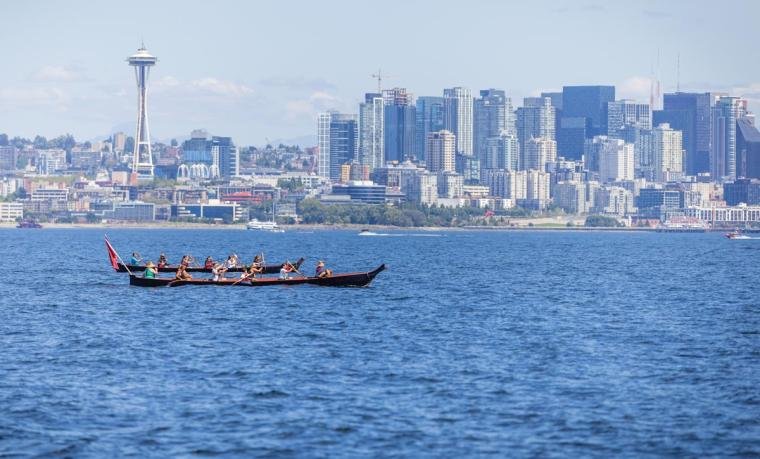
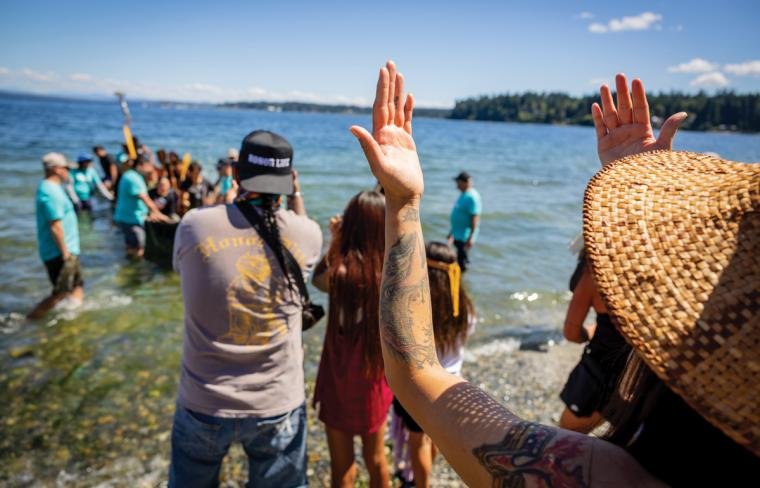
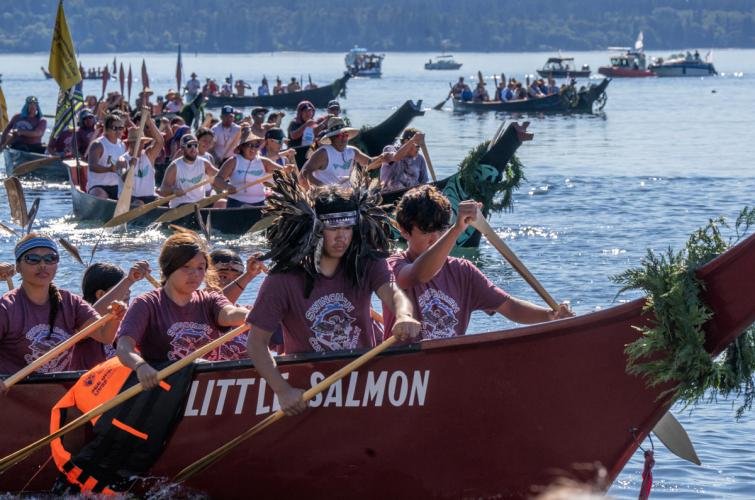
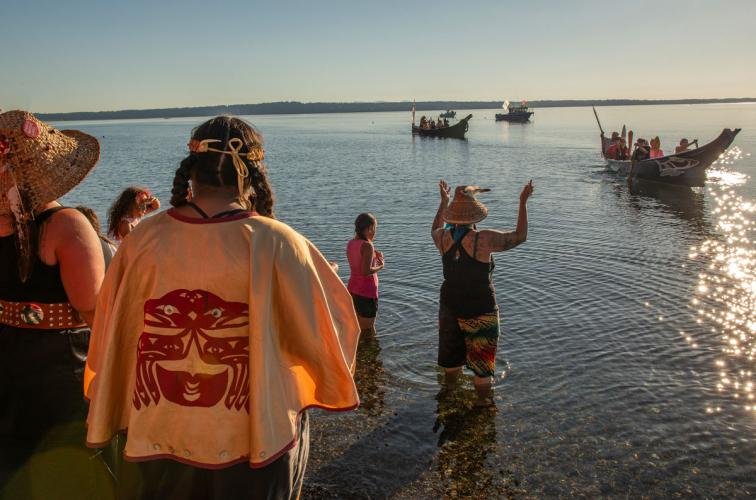
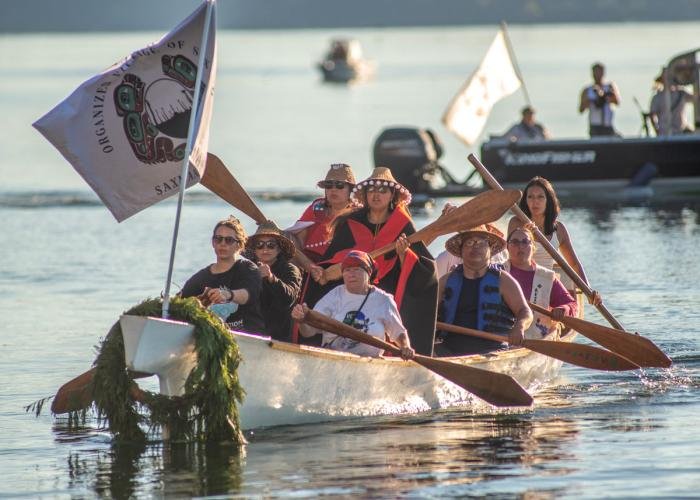
Some crews had traveled for more than two weeks on this year’s Medicine Creek Potlatch Journey, starting from places such as the Ahousaht First Nation on Vancouver Island in British Columbia about 300 miles north. Many had to paddle, or as these canoers say, “pull,” for more than 20 miles a day between communities. At each place they landed, community members welcomed the travelers. The canoes carried six to 16 crew members led by a skipper and were often supported by others on other boats or traveling on land. Some of the dugout canoes can be more than 40 feet long, much like the whaling and war canoes of the past. Once at their landing spot, the crew held their paddles up to indicate their peaceful intentions, as historically has been done when visiting another’s territory. One of the crew then stood and requested permission to land: “We’re tired and hungry and cold and would like to come ashore. Can we please come ashore?”
“Welcome to Suquamish lands,” the tribe’s Chairman, Leonard Forsman, responded. “We’re grateful to have your canoe in our waters, so come ashore with your medicine and your songs to celebrate this year’s canoe journey.”
The two-day layover at the Suquamish’s land for ceremonies, food, showers and socializing was a welcome break before many continued pulling the next 11 nautical miles to Alki Beach in west Seattle to join the Muckleshoot Indian Tribe and then the Puyallup Tribe before reaching their final stop at the Nisqually Tribe’s shores some 50 miles away. There, everyone was invited to participate in six days of potlach feasting and ceremonies to conclude this year’s journey.
Reviving a Tradition
Journeying by canoe has been a critical and traditional means of transportation, diplomacy and trade for Indigenous peoples since time immemorial. Canoes have been used to fish from rivers and along the coast as well as travel between Native communities, where tribes could renew relationships through cultural events. Canoes also have been used for burial of significant community leaders.
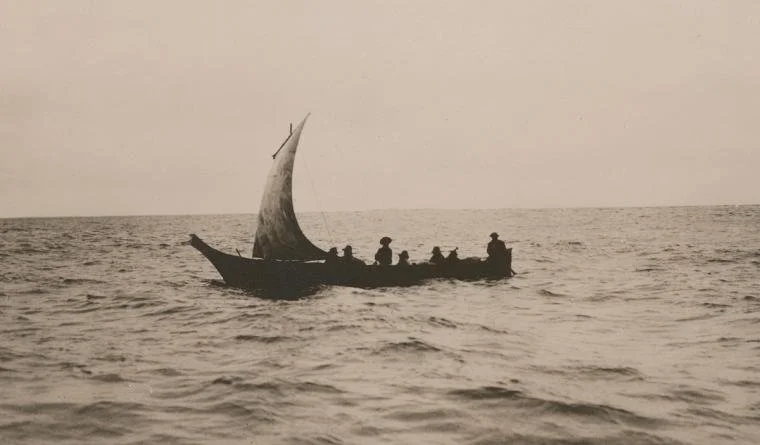
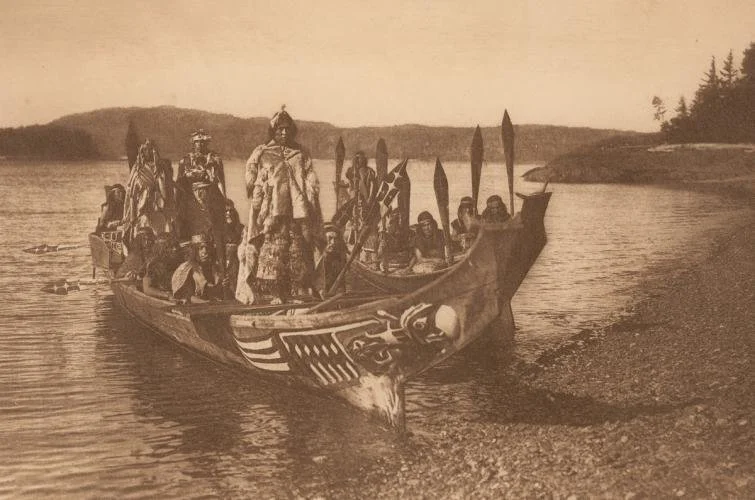
The canoes of the Coast Salish and Alaska Native peoples historically ranged from small flat-bottomed, shovel-nosed river canoes used for fishing and hunting to larger ocean-going canoes with upswept bows, racing canoes and dugouts up to 54 feet long with crews of 10 plus a skipper. The latter canoes could carry 5 tons of freight or many warriors during times of conflict, such as the early 19th century “otter wars” between Tlingit communities and Russian hunters off Alaska. Some ocean-going canoes of the Makah and Nuu-chah-nulth peoples were designed with greater volume and stability for harpoon whaling off of what is now Washington state and British Columbia.
Canoe makers and skippers have been highly respected members of their communities. However, with cultural and physical displacement along with the introduction of outboard motors and aluminum skiffs, the skills associated with crafting and navigating canoes became harder to pass down through the generations. That has changed in recent decades, as Native peoples have begun reconnecting with their traditions.
The Nisqually’s 2026 Medicine Creek Potlatch Journey was so-named to commemorate the Medicine Creek Treaty of 1854, one of several treaties signed with Washington tribes that formed the basis for today’s tribal fishing rights. Tribes retained their right to fish, hunt and gather as they always had in the treaties, and the 1974 Boldt Decision reaffirmed those rights. The federal ruling gave half the salmon catch in western Washington to the treaty tribes and led to today’s co-management of the fishery along with the state. The U.S. Supreme Court upheld the Boldt Decision in 1979.
Hweqwidi Hanford McCloud, a Nisqually voyage organizer, cultural educator and canoe skipper, recalled, “I’ve been fishing since I was 10 with my father and family. I’ve been a geoduck diver. Water is a big part of me and my family. Canoes were our main transportation so this year we’re honoring our ancestors’ paddle through the waters.” He was visiting the Suquamish reservation with a tribal delegation, including ceremony organizer and security coordinator Jeff Choke (Nisqually), to plan logistics for the end of the 2026 journey.
In 1989, 17 tribal nations helped revive the North Pacific Coast tradition of canoe journeying at an event known as the Paddle to Seattle. They came together to do their final pull into Seattle from the Suquamish waterfront. “This is the place where the two main canoe bands—the Salish Sea and Outer Coastal tribes—converge, which is why this location was chosen,” explained Forsman.
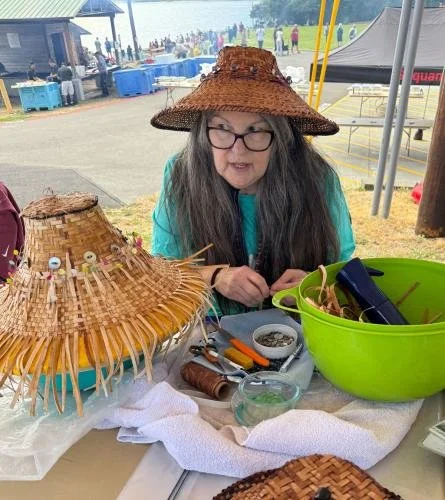
During the celebrations on Suquamish land on this year’s journey, Suquamish tribal elder and master weaver Barbara Lawrence was seated at an information tent. She was working on cedar-bark hats. She recalled that leading up to Washington state’s centennial in 1989, the governor approached her to come up with a project to represent tribal nations in the region, which led to the Paddle to Seattle.
“Barbara was on the state commission and Emmett Oliver (Quinault), a canoe racer, said ‘We’ll bring our racing canoes,’ but the elders said, ‘Give us the trees to carve canoes,’” recalled Forsman, “and that was the birth of the Journey.”
“They got us access to old growth cedar and the Washington National Guard brought us an old tree,” Lawrence explained with a smile while working a needle into a strip of soaked inner red cedar bark. In 1989, few dugout canoes were available on Puget Sound, and so her community borrowed a decades-old canoe from the Suquamish Museum, where both Forsman and Lawrence worked at the time.
“The night before the paddle, Frank Brown stood up and challenged us to come to his community in four years and the Quileute [from the outer coast of Washington] gave him a paddle and said ‘We’ll come and get it back,’” Forsman recalled, “which they did.” Brown, a Heiltsuk Hereditary chief from Bella Bella, British Columbia, also became the executive producer of “Sacred Journey,” a traveling exhibition about the resurgence of ocean-going canoes. He recalled an even earlier paddle in Canada. “In 1986, a World’s Fair Expo was held in Vancouver [British Columbia]. Its theme was transportation and communication. I pointed out that canoes were the original transportation,” said Brown. He skippered a crew from his Heiltsuk Nation in Bella Bella about 400 miles away. He said, “It took us 22 days, and no one had probably done that paddle in a hundred years.” Three years later, he skippered a crew in the Paddle to Seattle. He recalled, “Ten of us went down from Vancouver. We had young families, and some Lummi ladies helped my wife with our two babies and that was the first ground crew,” he said, grinning at the memory.
When he challenged the Paddle to Seattle canoe crews to come to Bella Bella in 1993, “It was like a fire. The tinder was set, and it just took that spark,” said Brown. “It captured the imagination of coastal Native nations.” The theme of the journey that year was “A Stroke Towards Indigenous Unity.” The Heiltsuk Nation hosted the canoe journey again in 2014.
The Journeys’ Unifying Power
This past year, dozens of communities hosted the canoe voyagers as they traveled over half a dozen routes across the Northwest’s Salish Sea and around from the outer coast of Washington state before making final landfall near the Nisqually reservation. The canoes carrying tribal and family members have names such as Beauty, Blue Heron, Eagle, Sacred Water, Seawolf, Sea Foam, Salmon Dancer and Little Salmon, the latter powered by a crew of youth.
The canoe crews “pull” their paddles through the water, some through 10-foot-high ocean waves, before reaching the shore. Any member of the tribe can be selected by council members to welcome a canoe’s crew. Once the canoers are granted permission to step on the host tribe’s lands, they beat their paddle handles on their crafts’ bottoms to express gratitude before wading ashore.
During this year’s canoe journey, the Suquamish Tribe and its members had six canoes, including two dugouts from a cedar tree felled in Vancouver, Canada, in 2000, where local youths were sent for six weeks to learn lost canoe building skills from Squamish canoe carver and artist Ray Natraoro.
One of the first canoes to make landfall at the Suquamish community in late July was The Judge. Its crew and skipper, Bradley Hatch, were from the Hoh River Chalá·at Nation in western Washington state. They started out from the Quileute Tribe’s land on Washington’s western coast and spent more than 40 hours on the water over seven days. “We’re making our ancestors proud,” Hatch said, adding they are “healing through paddles and songs.”
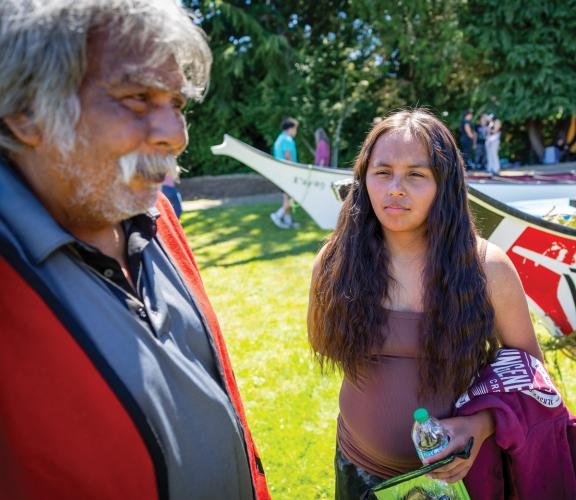
Mya Fisher, 23, and her brother, Daki Fisher, 16, were recently appointed co-chiefs of their Chalá·at people’s Hoh Tribe, taking on the role held previously by their father. “This is my first pulling all the way,” Mya explained. “I’m powering through it, though I’m sore.” Last year, she pulled from La Push to Neah Bay, on the outer coast, over some 40 miles of open ocean. “It’s been a learning process, a chance to make decisions,” she said. “And I’m ground crew in training,” her brother, Daki, added with a grin.
Their grandfather, Dave Hudson (Quileute), was with them. In 1976, he and friends paddled from La Push to Neah Bay on the northern tip of the Olympic Peninsula in Washington state. “Just friends traveling on our ancestorial highway as our forebearers did,” he recalled. “It is all nature on the outer coast, and we saw and felt it. On either side there were the fish and animals, and we’ve got songs and canoes handed down generation to generation from that one canoe to what you see here today.”
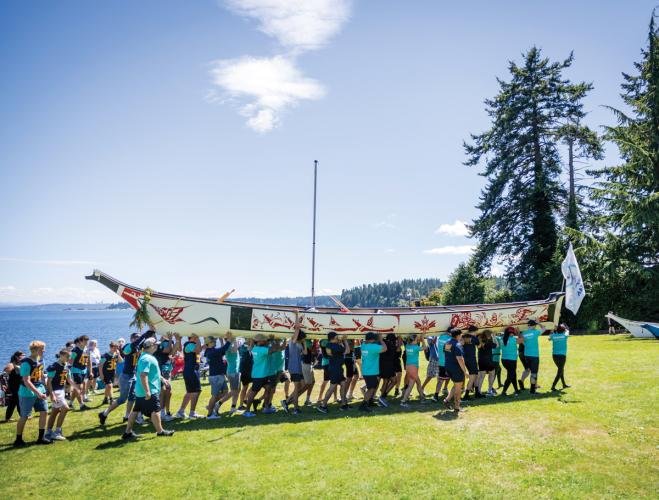
After landing, the crews and volunteers— including 30 sailors from the Naval Base Kitsap and the Bainbridge High School varsity football team—lifted the canoes above their shoulders. Some weigh a half a ton, so carrying them up a steeply inclined boat ramp is no easy feat. There, in front of a modern longhouse known as the “House of Awakened Culture,” the canoes were arrayed in parallel rows. Later, as more canoes arrived, they were diverted to an additional grassy area by the dining tent.
One of the canoes on the grass in front of the longhouse was the aptly named Beauty, a sleek red and yellow cedar canoe with additional fiberglass and Douglas fir elements. Its 10 pullers and skipper had traveled some 80 miles over four days, cutting through the water with naturally striped alder paddles. The name Beauty honors both tradition and a deceased mentor. Raven and Free Borsey (Lummi), 25-year-old twins, joined the Lummi Youth Canoe Family when they were 12 years old. Its skipper, environmental activist Justin Finkbonner (Lummi), died when they were 15, and the canoe fell into disuse. But then, “we got it back from the [tribal] council, and we repaired it last year and this year just did the finishing detail,” Raven said. “So now it’s a canoe that’s good for 25 years, for other generations to use for healing.”
All day long, Suquamish Council Member Luther “Jay” Mills had been helping prepare food at the roofed “Fish Pit.” Volunteers split logs to stoke a fire under a cement oven, on top of which two more were flipping metal-handled grilling racks holding 50 salmon fillets each. “I’ve been helping coordinate the cooking since 2009,” Mills said, smiling through a light sheen of smoky sweat. “We’ve got 1,000 sockeye [salmon], 2,500 pounds of manila clams and 300 dozen oysters.” Next to the Fish Pit, they were heating piles of rocks to steam the shellfish. That evening 6,000 people—elders, skippers and crew first—formed lines to be served salmon, crab and shellfish along with corn, potatoes and biscuits.
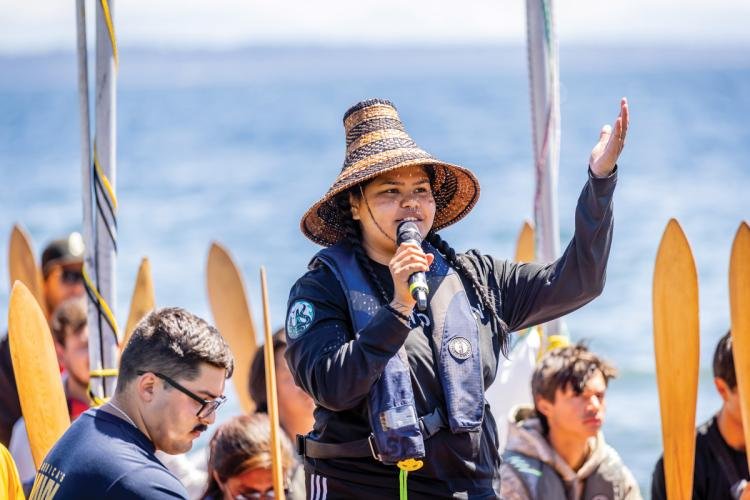
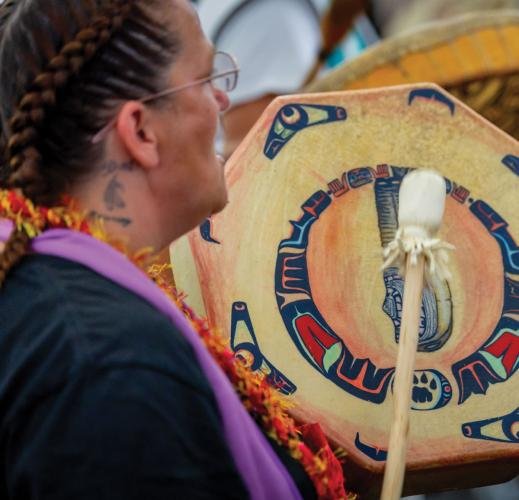
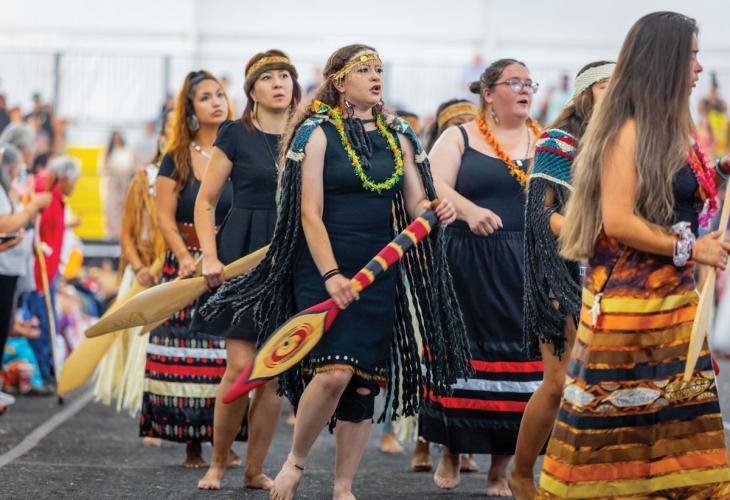
After dinner, each tribe hosted its own Protocol ceremonies. Here, they were held in the “people’s house.” Built in 2008 out of red cedar, it is the largest longhouse in the Pacific Northwest. There was drumming, songs and dancing, including dances by many youths in regalia, with over 1,000 people in attendance the first evening and through much of the following day. Many wore traditional Salish cedar bark hats. Some were social dances but several were intended to honor the journey itself. In one, lines of women and girls carried small paddles, pulling them through the air as if it was water. The songs were both traditional and original, some written by youth, learned from elders or given as gifts from one nation’s voyagers to another.
Outside, dozens of young dancers were lined up for their tribe’s or canoe family’s turn at Protocol. Liz Satiacum (Quileute), a member of the Ocean Going Canoe Society, recalled her participation in the 1989 Paddle to Seattle. “At least 10 of us still travel with the Journey,” she noted proudly. “Our tribe was still making dugout canoes at the time, and it took us 14 days from La Push [on the outer coast] to Seattle and back with no ground crew or support boats. When we got into Seattle, there must have been 100 TV cameras on the jetty.”
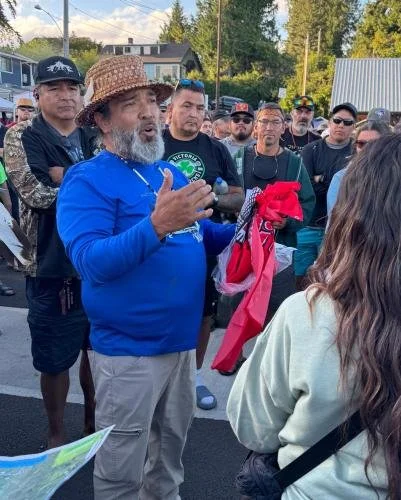
Early the second evening, about 100 skippers met by the community’s pier to prepare for the next day’s paddle to the Muckleshoot’s land. They learned that low tide would be at 11:30 a.m., and so crews could begin departing around 7 a.m. It’s about a five-hour pull, and the Coast Guard did not want anyone lingering in the shipping lanes. Jeff Choke announced that, “I come from Nisqually. We’re making this destination fast as possible to bring your spirit to our territory and bring your canoe family and all your medicine.”
The next morning, canoes departed across sun-sparkled water below an azure blue sky. The horizon was dotted with 15 to 20 canoes already heading toward Seattle. On the rocky beach, aboard the Beauty, Raven Borsey’s 4-year-old daughter, Dem-I-Thia (Lummi), was standing on one of the puller’s seats in a small life jacket. “You have something to ask?” her dad prompted, but surrounded by all the viewers, she was too shy to speak, so 15-yearold skipper-in-training Adrian Revey (Lummi) said the words she had practiced for her: “We are humbly asking to leave your shore.”
“Thank you, relatives, for coming to share your songs and your health and your prayer with us. Enjoy the saltwater and the sun,” came the response from Suquamish tribal member Charles Lawrence, and they pushed off.
In keeping with tradition, the crew of each host tribe are the last to depart their shores to the next destination. Two Suquamish canoes hung suspended from davits aboard the Challacum, a 55-foot landing craft type workboat used to haul shellfish and maintain salmon pens. On the journey, it served as a voyage support vessel. Clear of the docks the two black and red dugouts—Killer Whale and Honorable One—were lowered into the water and the first crews climbed into them. They would come back to the support boat during the crossing to switch pullers and make sure everyone who wanted a chance to paddle got one.
Puget Sound was calm, so the canoes made good time. The Suquamish aluminum dive boat approached, coming alongside the Challacum to hand over some net bags of geoduck, a large mollusk clam. There is a partial crew change on the Honorable One for the final 2-mile leg. Taking the lead puller seats just behind the bow were Antonia Ewing and Desean Santos, youth sporting their Suquamish Tribe tee shirts. Ewing started a fast count up to 100 as the two of them set a determined pace for the other 11 in the canoe. At the first count of 100 she started over. By the time they have completed their fifth hundred count, Honorable One was in view of Alki Beach. Another 10 minutes of pulling and their paddles were up as it glided onto the sandy beach along west Seattle’s shoreline in sight of waterfront homes, seafood restaurants and a coffee shop. They were welcomed ashore by the Muckleshoot, who had arranged shuttle buses to canoe family campsites. Getting out of her craft, Ewing was greeted by her mom, who is also Santos’ aunt.
On this year’s journeys was a white 28-foot-long canoe that was shipped down from Alaska and launched from the Lummi Nation’s land in northern Puget Sound. It belongs to the Teesh Kwaan Xaguc canoe family, including Ginger McCormick (Tlingit), an enthusiastic promoter and resident of the Organized Village of Saxman 3 miles south of Ketchikan in southeast Alaska. “I’ve been on Canoe Journey many times, and my Auntie Candice Williams said, ‘The Tlingit way is to give back, and we would have the Shame Pole if we don’t balance things,’” she recalled. Her village of 400 will be hosting the next canoe journey, which will have the theme “Echoes of our Ancestors through the Trade Waters.”
The 2028 hosts will be the Wei Wai Kai and Wei Wai Kum First Nations of Campbell River, British Columbia. In 2029, the Suquamish will again host the voyage for its 40th anniversary as they did for the first in 1989 and the 20th in 2009. Planning for the canoe journey in 2029 has already begun. Suquamish tribal elder Patty Medina has begun working to meet her pledge of making 1,000 necklaces for giveaway items. “They’re made with glass and bone and sewn with deer sinew,” she explained. “I’ve already made 100 necklaces in a month, so I think 1,000 is realistic.”
The canoe fleet had grown to more than 100 by the time they reached the Nisqually landing sight, with the pounding rattle of paddles from hundreds of proud crew members, arms sore but grateful for having made the journey. Barbara Lawrence said of the journey’s revival, “We had no idea this would open up [the way] to language and culture. But you know a huge part of our life is being in canoes. It’s who we are."